A new turbine inside a 1965 power plant
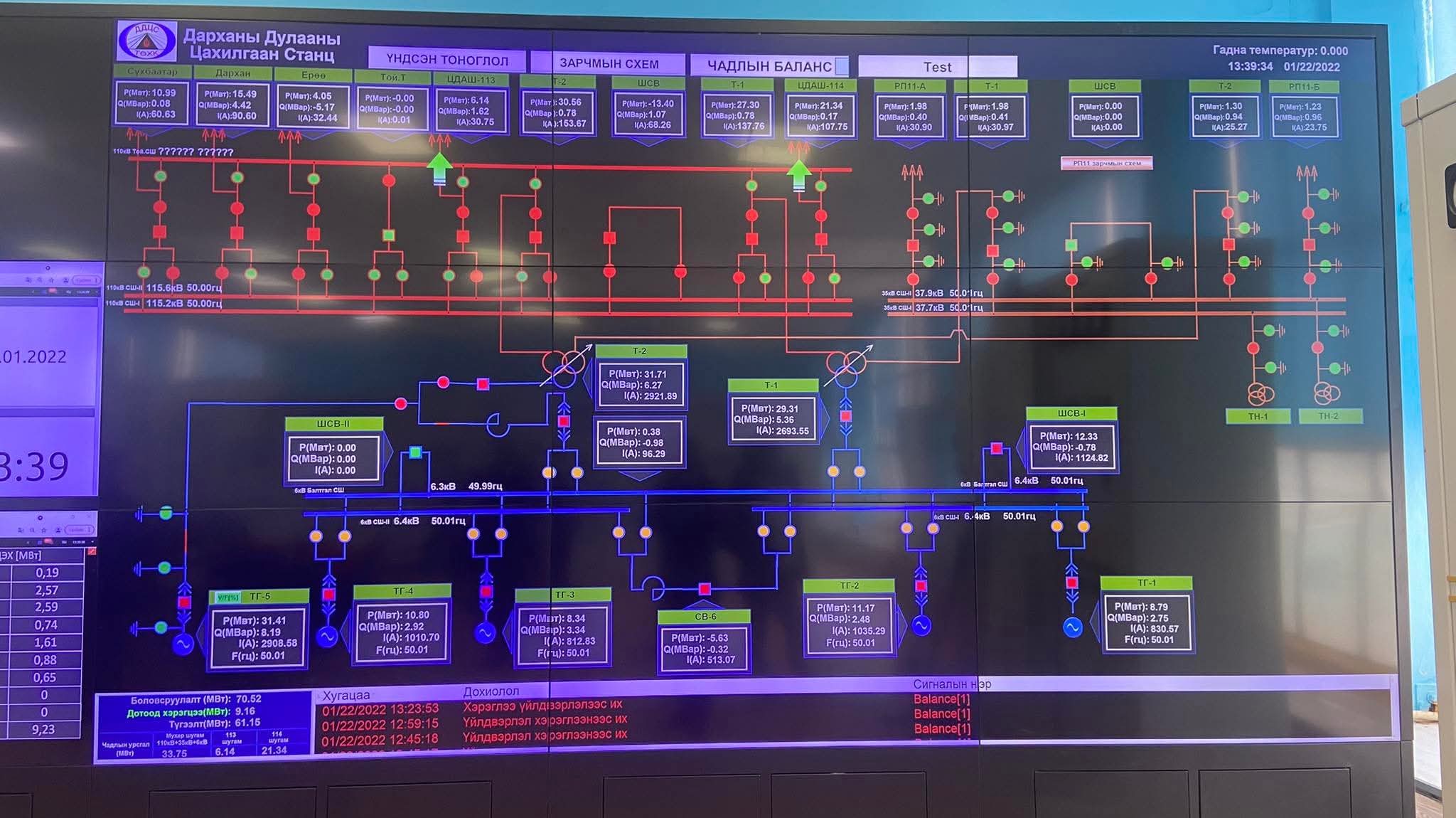
At first glance, this control-room screen looks like a solved problem: red high-voltage buses, blue generator buses, green arrows, and a clean 50.01 Hz.
The interesting part is not that the diagram is old. It is that old and new equipment are operating on the same diagram.
The screen is from Darkhan Thermal Power Plant in Mongolia. The station’s first
equipment entered service in 1965. But the large TG-5 value near the lower
left—31.41 MW—belongs to a fifth, much newer machine.
That distinction matters. Darkhan did not somehow convert one 1965 generator into a modern 35 MW generator. It expanded a legacy plant around it.
The alpha is the interface tax: the new component can be excellent while the inherited system still decides how much value reaches the boundary.
- It was an addition, not a conversion
- What the screen actually says
- The difficult sentence in the retrofit record
- Capacity arrived through a project, not a purchase order
- Why 35 MW mattered beyond Darkhan
- The same pattern from grid to gate
- Where the alpha actually is
- The strongest counterargument
- Evidence boundary
It was an addition, not a conversion
Mongolia’s Energy Regulatory Commission says the plant’s foundations were laid in 1963 and its first main equipment was commissioned on October 2, 1965. In October 2019, the station inaugurated a new 35 MW turbine-generator as its third major modernization.
The turbine manufacturer is even more explicit: Kaluga Turbine Works calls it the fifth power unit. Its account says the existing plant had four 12 MW turbines totaling 48 MW and that the additional machine increased capacity by 35 MW.
So the nameplate arithmetic is:
| Before | Added | After |
|---|---|---|
| 4 × 12 MW = 48 MW | 35 MW | 83 MW |
That is a 73% increase in installed electrical capacity.
KfW’s project record describes financing for an extension of the turbine hall, a new 35 MW steam turbine, and associated auxiliary equipment. The ERC announcement calls the result a 35 MW expansion. The OEM account calls it unit five.
“Modernization” is therefore the right word for the station project. It is the wrong mental model if it suggests that every inherited subsystem became new. The published scope establishes a new turbine, generator, hall extension, and auxiliaries. It does not establish wholesale replacement of the plant’s steam supply, coal and water systems, district-heating duty, switchyard, protection, or operating organization.
What the screen actually says
The bottom-left summary and five generator tiles make the operating point reconstructable:
| Screen reading | MW |
|---|---|
| TG-1 | 8.79 |
| TG-2 | 11.17 |
| TG-3 | 8.34 |
| TG-4 | 10.80 |
| TG-5, the new unit | 31.41 |
| Sum of generator tiles | 70.51 |
| Displayed gross generation | 70.52 |
| Station internal consumption | 9.16 |
| Displayed distribution | 61.15 |
The tile sum and displayed gross value differ by only 0.01 MW. From that one instant we can derive four useful facts:
- The station was producing about 85.0% of its 83 MW installed capacity.
- TG-5 was at about 89.7% of its 35 MW nameplate.
- The new unit supplied 44.5% of the station’s gross generation.
- Internal consumption was about 13.0% of gross generation.
The four legacy units together produced 39.10 MW, or about 81.5% of their combined 48 MW nameplate. This was not a scene where the new machine ran while the old plant sat idle. Both generations of equipment were carrying the load.
Gross generation minus displayed internal consumption is 61.36 MW, 0.21 MW above the displayed distribution value. That small residual could be rounding, losses, timing, or a metering-boundary difference. A photograph cannot tell us which—and pretending otherwise would turn a good observation into a fake result.
What it does show is the right unit of value: not generator nameplate, but power that survives station service and reaches the distribution boundary.
The difficult sentence in the retrofit record
A separate Darkhan automation case study contains the most important line in the project history:
Additional equipment was needed for the increased capacity, and the existing automation system was too old to interface with it.
The SATEC case study says the prior Russian fault-recording and automation equipment had been commissioned in 2002. The retrofit did not wave that boundary away. It built a new observability and control layer around it:
- 39 power-quality analyzers;
- three Ethernet switches, a server, five cabinets, and a satellite-synchronized clock;
- 380 analog signals and 624 status signals;
- 88 calculated parameters and 420 triggered alerts;
- one-second monitoring and dispatch updates;
- common fault waveforms, event history, metering, and mimic diagrams.
That is 1,512 measurements, states, derived values, and alerts before counting the thousands of parameters available inside the analyzers themselves.
This is what brownfield modernization often looks like in practice. The visible artifact is a turbine. The integration work is signal definitions, current transformers, time synchronization, protocols, alarm semantics, operator screens, fault behavior, and deciding which system owns the truth when readings disagree.
The screen in the photograph is therefore more than presentation. It is part of the machinery that lets a plant with two generations of equipment be operated as one system.
Capacity arrived through a project, not a purchase order
The upgrade also took years rather than one equipment-delivery cycle. A 2017 report said the expansion had been underway since 2012 and that its original €16–17 million estimate was insufficient. KfW now records a €20 million German financing contribution and marks the program complete.
The exact financing history is less important than the pattern: brownfield work must fit outages, civil works, procurement, foreign suppliers, spare-parts strategy, commissioning, and the operating obligation of a plant that cannot simply disappear while being upgraded.
Kaluga’s 2019 account says the parties were already discussing replacement of two exhausted older turbines and how common equipment could simplify future maintenance and spares. Commissioning one new unit did not end the legacy problem. It changed the next version of it.
Why 35 MW mattered beyond Darkhan
The national operating context makes the capacity more consequential. The Energy Regulatory Commission’s 2022 review says Mongolia imported 20.9% of the electricity it consumed that year. It also says combined heat-and-power plants were operating at full capacity during the central grid’s winter peak without backup equipment.
A well-loaded 31.41 MW machine inside an 83 MW plant is not a demo in that system. It is material capacity.
But material does not mean independent. TG-5 still needs the plant around it: steam, cooling, excitation, protection, station service, dispatch, operators, and a path through the 6 kV, 35 kV, and 110 kV network shown on the screen.
The same pattern from grid to gate
This is the connection to my power-electronics and chip work. The physics and scale change; the architecture question does not.
| Layer | New component | Inherited system that can erase the gain | Evidence that matters |
|---|---|---|---|
| Darkhan | 35 MW turbine-generator | steam, auxiliaries, controls, protection, switchyard, district heat | gross-to-net power, faults, availability, synchronized telemetry |
| VoltForge | optimized GaN/SiC converter stage | magnetics, EMI, loop stability, cooling, protection, calibration | measured efficiency curves, transients, thermal and compliance tests |
| LCA-1 | lattice-cryptography arithmetic engine | bridge protocol, host transfers, memory, board power, thermals, security | real-backend workload, differential tests, synthesis, joules per completed operation |
I have now made that last connection executable. LCA-1 defines a versioned
time-domain trace with idle, kem, dsa, dma, zeroize, and fault
states. VoltForge’s
workload-power integration
parses the trace, requires measured watts by default, integrates energy, keeps
peak and slew behavior, and turns the peak load into a converter design input.
It deliberately does not collapse the trace into a made-up TDP. A cryptographic operation is a burst, and the board must survive its load step, not only its average.
The underlying bridge workload is pinned to the public Entanglement Transfer Protocol: ML-KEM-768 seals the lattice key; ML-DSA-65 authenticates commitments and relay envelopes. LCA-1 itself remains private while the architecture is pre-FPGA, so I am not presenting unfinished RTL as a public chip claim.
Where the alpha actually is
The obvious story is “old coal plant gets a bigger turbine.”
The more reusable story is this:
A component upgrade creates value only after every inherited interface agrees to carry it.
That suggests three engineering bets:
- Observability is part of capacity. If old and new systems cannot share time, measurements, alarms, and fault records, installed hardware is harder to operate and trust.
- The useful metric lives at the system boundary. Darkhan’s screen separates 70.52 MW gross from 61.15 MW distributed. A chip project should likewise report completed bridge operations and joules at the board, not isolated butterfly throughput.
- Interfaces are products. The trace between LCA-1 and VoltForge is not glue. It is the contract that turns a workload into regulator, decoupling, thermal, and protection requirements.
The new turbine is impressive. The durable alpha is learning to price the system it inherits.
The strongest counterargument
A thermal power plant is not a chip, and a plant retrofit is not a semiconductor design flow. Their safety regimes, economics, time constants, and failure modes are radically different.
The analogy should not be stretched past one architectural claim: local component performance is not end-to-end system performance. The evidence required at each layer remains specific to that layer.
Evidence boundary
The operating calculations above come from one photographed screen at one instant. They do not establish annual generation, heat output, efficiency, availability, emissions, or causal performance improvement. Translations of the on-screen Mongolian labels are functional descriptions, not vendor-defined metering terminology. The automation details come from a vendor case study and should be treated as implementation evidence, not an independent reliability assessment.